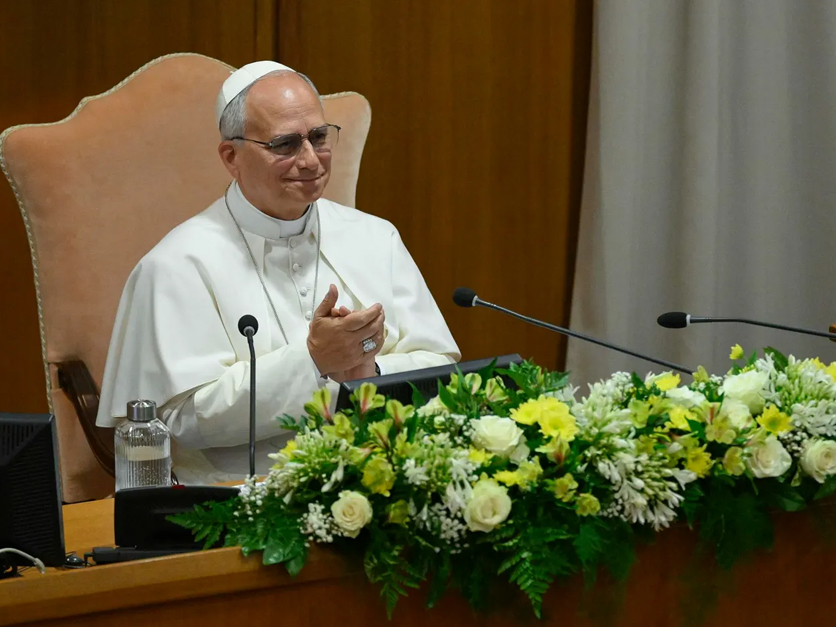
 In Magnifica Humanitas, the first papal encyclical devoted to artificial intelligence (AI), Pope Leo XIV warns: “Humanity, created by God in all its grandeur, is today facing a pivotal choice: either to construct a new Tower of Babel or to build the city in which God and humanity dwell together.” This encyclical comes at a moment when colleges and universities are struggling to determine how to both use AI and preserve human judgment, creativity, and dignity within institutions that are increasingly shaped by automation and efficiency. For Molloy University business professor and AI and higher education expert Alex Chan, these questions are central to the future of colleges and universities.
Throughout Magnifica Humanitas, Pope Leo argues that AI is more than a technological development; it is a moral and social force that will reshape labor, democracy, truth, and human relationships. He warns readers against a “culture of power” fueled by technological concentration and efficiency-driven thinking. From Chan’s perspective, these pressures are already present across higher education. He shared with me: “In education, the way that these risks are playing out is that elite universities forge exclusive partnerships with governments and corporations, securing privileged access to advanced AI tools and proprietary data while most public institutions and students fall further behind.” He added, “This concentrates power and widens inequality.”
Chan’s concern is similar to one of Pope Leo’s central warnings. In the encyclical, Pope Leo argues that technological systems increasingly shape access to opportunity, information, and participation in public life. He calls on institutions to ensure that AI serves “the common good” rather than deepening social stratification or concentrating influence in the hands of a few powerful individuals.
Chan believes that higher education must become more intentional about cultivating moral reasoning and creativity; it cannot merely retreat from AI. He argues that the challenge AI poses to higher education is both structural and pedagogical. In his TEDx Talk, Chan compares AI to a “magic wand” suddenly handed to pastry chefs in training. “At the wave of this wand, in an instant, they could conjure up perfectly fine cakes that would have taken them years to learn how to make.” But if everyone possesses the same technological advantage, technical proficiency alone will no longer distinguish students. Chan believes that what matters is innovation, judgment, and human understanding. He explained, “How do you make your cakes stand out amongst cakes from other competitors? You can only do so through innovation and differentiation.”
Chan also stated, “When students are learning something new, it should not be done with the sole purpose of producing an outstanding essay and getting a high score. AI can gather good information for them and lay it out in a logical manner. But they must think of whom this information will be useful to and why it is important.” This idea also appears in Magnifica Humanitas, with Pope Leo arguing that human beings cannot be reduced to efficiency metrics, predictive profiles, or data systems. Chan notes that universities must resist this impulse.
One of the interesting comparisons Pope Leo makes in Magnifica Humanitas is to the Industrial Revolution. When I asked Chan his thoughts, he explained, “AI is presenting challenges on a similar scale to the Industrial Revolution. There were also worries that power and influence were being concentrated in the hands of a few. In this country, railroads were built and owned by a handful of Robber Barons. In England, Luddites smashed machines in factories in fear of losing their jobs. All these unfair situations and turbulence will probably also appear in the age of AI.” He added, “The lesson of magnificent human nature that I draw from this is that somehow, we always manage to muddle through.”
Pope Leo’s concern about efficiency replacing humanity is particularly relevant as universities rapidly adopt AI systems for advising, grading, admissions, and student support. In the encyclical, he cautions that technological efficiency cannot replace conscience, responsibility, or empathy. Chan agrees that institutions risk crossing a dangerous line when they surrender human responsibility entirely to automated systems. He noted, “AI can come up with the information on advising what courses a student should take in the coming semester, but the faculty advisor should still be able to determine if the logic behind the advice given by AI is sound.” He added, “If the faculty delegates completely to AI at any of these 3 key stages, then they would be failing their students.”
From my perspective, one of the most striking aspects of Magnifica Humanitas is that Pope Leo avoids framing AI as inherently evil or anti-human. Instead, he argues that societies must both intentionally and ethically shape technological systems before they become fully embedded in daily life.
Chan responded to Pope Leo’s thoughts, explaining, “Humans are good at adapting and pivoting with emerging situations. Sometimes it might seem a bit scary as it takes a lot of time to get things right.” That said, he admitted that colleges and universities are still navigating unfamiliar territory. Chan stated, “Do I think higher education leaders are approaching AI with enough seriousness and long-term thinking? The short answer is probably no. But it is no fault of theirs. No one has a perfect crystal ball, and sometimes it does not matter how hard you stare into it; the vision will still remain murky. But this is okay as long as they have good common sense and the courage to make decisions to act.”
At the center of both Magnifica Humanitas and my discussion with Chan is the same question: What does it mean to remain fully human in an age increasingly shaped by machines? Pope Leo urges people to “remain human” and to build technological systems grounded in “shared responsibility and communion.” Chan believes educators preserve humanity by helping students see themselves as people responsible for others. He stated, "When students have this clear picture, they will naturally exercise their own creativity and judgment. They will not see themselves or others as just something to be measured by metrics and algorithms. Instead, they begin to feel their own humanity and agency because they are thinking about how to create real value for actual human beings.”
For more information visit Forbes.com