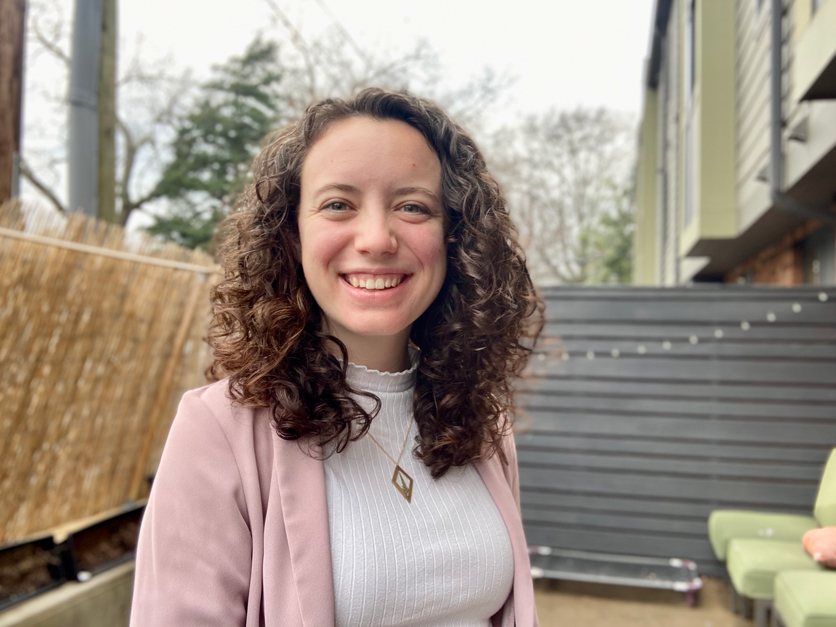
 When people think of music, they most often think of something that entertains, inspires, or brings people together. Hayley Richbart ’18 learned to see music as something much more: a way to communicate, build trust, and support people through some of life’s most challenging circumstances.
Through Molloy University’s Music Therapy program, Richbart discovered an approach to care and advocacy that would guide her far beyond her first career, eventually leading her from working as a music therapist to pursuing a career in law.
“The connection is more direct than it might appear at first,” Richbart said. “My background in music therapy wasn’t separate from the legal work I was doing, but instead directly shaped how I approached that work.”
Music therapy is a clinical, evidence-based profession that uses music to help individuals achieve personalized goals, including strengthening communication, emotional expression, and overall well-being. At Molloy, students combine their passion for music with coursework, clinical experiences, and a commitment to serving others.
For Richbart, who graduated from Molloy in 2018 with a Bachelor of Science in the subject, the field represented the intersection of two things that had always mattered to her: creativity and community.
“I grew up in a family where giving back to the community was extremely important,” Richbart said. “When my father passed away, my family relied heavily on the support of our community. Experiencing that support firsthand showed me how powerful community and connection can be. Music therapy felt like a natural way to combine two things I cared deeply about: helping my community and music.”
After graduating, Richbart began her career as a music therapist supporting students with developmental disabilities and emotional challenges. The experience strengthened her ability to connect with individuals, understand their needs, and advocate for them as whole people.
“One of the most valuable lessons I learned at Molloy was how to understand individuals as whole people rather than as their diagnoses, circumstances, or labels,” she said. “My role as a music therapy student was to create meaningful connections and help people feel seen and heard.”
Those lessons would later become central to a new chapter of her journey. Her interest in law first began at Molloy during an ethics course that explored issues surrounding human rights and justice. The conversations challenged her to think more deeply about the
systems that shape people’s lives and inspired her to volunteer at a refugee center in Hempstead. After working as a music therapist, serving with AmeriCorps, and supporting asylum seekers as a case manager, Richbart saw how she could expand her passion for advocacy through the legal field.
“I saw how legal structures directly shape people’s lives, and how attorneys can be agents of change in those systems,” she said. “At that point, I knew law school was the right next step.”
While attending the University of Virginia School of Law, Richbart focused much of her work on representing incarcerated individuals, including people facing capital charges and death sentences. Although the environment was different, she found herself relying on many of the same skills she developed through music therapy. The ability to listen, build trust, communicate clearly, and recognize the person behind a circumstance remained at the center of her work.
“Effective representation requires more than just legal knowledge,” Richbart said. “It requires you to listen carefully, approach each person without judgment, and recognize that they are more than their circumstances.”
As she begins her career as an appellate public defender, Richbart continues to carry the lessons she first learned at Molloy. “The skills I learned at Molloy such as listening, building trust, and meeting people where they are will remain central to my work,” she said.
For students who may be unsure where their own path will lead, her advice is to remain open to possibilities.
“No experience is wasted and no doors are completely closed for you if you stay connected to your values,” she said. “The skills, perspectives, and lessons you gain along the way continue to build on one another and eventually shape a path that is uniquely your own.”
For Richbart, music therapy and law were never two separate paths. They were different expressions of the same purpose: helping people feel heard, understood, and advocated for.
“Your path doesn’t have to look linear to be meaningful,” she said. “It just has to be yours.”