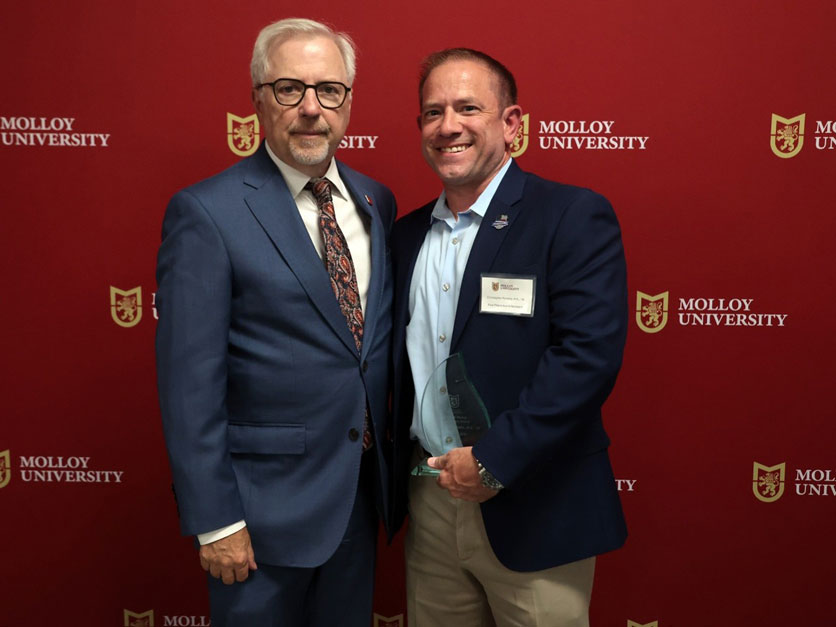
 Assistant Professor Mark James, from Molloy’s School of Arts and Sciences. Shares his thoughts on the passing of the Reverend Jesse Jackson, Sr., and the impact of his legacy.
Last week’s loss of civil rights icon Reverend Jesse Jackson, Sr, reminds us that the arc of the moral universe doesn’t just bend toward justice, as his friend and mentor, the Reverend Martin Luther King. Jr. is famous for saying it is bent that way. It is bent that way by those willing to stand up and bend it away from injustice, as Reverend Jackson and so many others did before, during, and after that “Bloody Sunday” on the Pettus Bridge in Selma, Alabama on March 7th, 1965.
In the years following that fateful event, Reverend Jackson founded Operation PUSH (People United to Save Humanity) in 1971, the National Rainbow Coalition in 1984, and united them as the Rainbow-PUSH Coalition in 1996. While focused primarily on improving social, economic, and political conditions for African Americans, these organizations advanced a conception of justice that sought to make life better for everyone.
In this spirit, he also ran for President of the United States in 1984 and 1988. While he did not win the primary in either of those years, his candidacy highlighted problems with the nomination process. The reforms he inspired have had a significant impact on how the Democratic Party chooses its presidential nominee to this day. For example, Barack Obama was a direct beneficiary of those reforms.
For Reverend Jackson, everybody was somebody. However, there are those who cannot feel that they are somebody unless they can treat someone else like nobody. Reverend Jackson’s loss at this time also reminds us that once bent towards justice, the arc of the moral universe will not stay that way, for there are those who regard the justice he sought as injustice.
So now Reverend Jackson’s legacy calls on us to reaffirm the four pillars of the university’s core values of community, service, spirituality, and study; to remember our mission to provide transformative education in the service of ethical leadership; and to insist that justice means all of us are somebody.