 Dr. Elizabeth (Liz) Suter, Associate Professor in Biology, Chemistry & Environmental Science at Molloy University, is at the forefront of environmental DNA (eDNA) research. Her work, in collaboration with Stony Brook University’s School of Marine and Atmospheric Sciences, focuses on using eDNA to monitor biodiversity and ecosystem health in estuarine and coastal environments.
As a Research Affiliate with Stony Brook’s Institute for Ocean Conservation Science, Dr. Suter leverages advanced sequencing technologies and autonomous sampling systems to study marine ecology and track species presence through genetic material left behind in water samples.
eDNA—genetic traces shed by organisms into their environment—has revolutionized ecological monitoring. Instead of relying solely on traditional sampling, scientists can now detect species from water samples, offering a non-invasive and highly accurate method to assess biodiversity. Dr. Suter’s research applies these techniques to critical habitats such as the Hudson River Estuary and the South Shore Estuary Reserve.
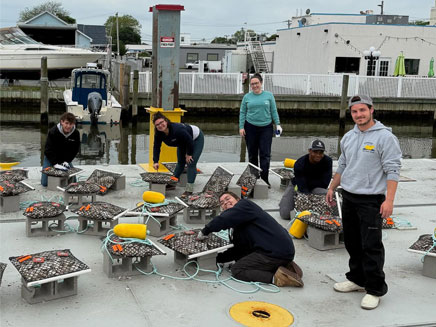
One of Dr. Suter’s flagship projects involves monitoring oyster reef restoration in Great South Bay. Working with partners including the Gino Macchio Foundation, Seatuck Environmental Association, and Cornell Cooperative Extension, her team uses eDNA to compare biodiversity across restored reefs, natural beds, and alternative habitats. This research informs conservation strategies and helps measure the success of restoration efforts.
Dr. Suter also contributes to the Shinnecock Restoration Project (ShiRP), where eDNA is used to detect fish, rays, and sharks in Shinnecock Bay, providing early insights into species recovery and ecosystem resilience.
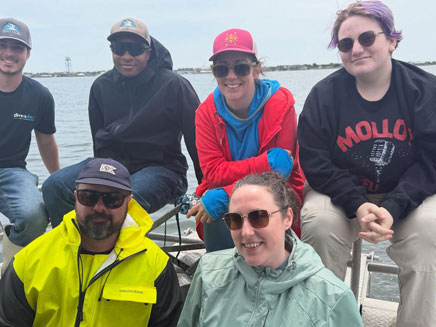
A defining feature of Dr. Suter’s research program is the close mentorship students receive throughout the research process. Molloy students work directly with faculty mentors, gaining hands-on experience that extends well beyond the classroom.
“In Biology and Environmental Sciences at Molloy University, undergraduate research is embedded in thecurriculum, and students get to work one-on-one with research scientists, guaranteeing that they gain hands-on experiences that they are unlikely to get at most other institutions,” said Dr. Suter.
Recent examples of student involvement include:
- Matthew Franolich and Joseph Benevento, Environmental Science seniors, who received summer stipends to work on oyster pathogen monitoring using portable sequencers. Their findings contributed to senior theses and were presented at the ASLO Aquatic Sciences Meeting in Spain.
- Dominique Di Domenico and Emily Bonacchi, who presented eDNA-based biodiversity research at Molloy’s Undergraduate Research Conference, showcasing the ecological impact of oyster restoration.
- Additional students who have shared their work at regional and national forums, including the New England Estuarine Research Society and Sigma Xi conferences, highlighting Molloy’s growing reputation in environmental science.
Dr. Suter’s partnership with Stony Brook University strengthens Molloy’s research capabilities and expands opportunities for student engagement in advanced scientific work. Her research exemplifies how applied science, academic collaboration, and individualized mentorship can drive meaningful progress in environmental stewardship.
Professor Liz Suter’s eDNA research is transforming how we understand and protect marine ecosystems—while empowering Molloy students to become the next generation of scientific leaders.