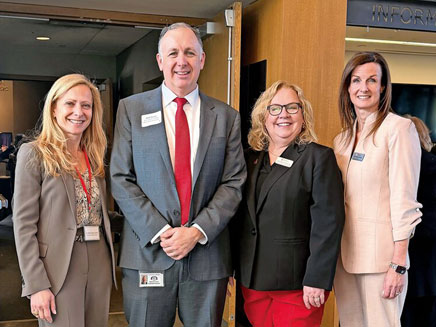
 Molloy University and the Nassau County Council of School Superintendents held the eduAI Summit at Molloy’s campus in Rockville Centre, welcoming approximately 250 educators and administrators from more than 50 institutions across Long Island.
“There’s been a lot of side conversations with districts about how to approach artificial intelligence and some of the pragmatic steps we should be taking, and there were a lot of questions about the technology too,” Rockville Centre Public School Superintendent Matthew Gaven said. “And I think that really came back to the Nassau County Council of Superintendents, and our technology committee really had some in-depth discussions about trying to widen that out.”
Spearheaded by Gaven, the “eduAI Summit: Shaping the Future of Learning” was an all-day event that served as a hands-on AI showcase. It brought together educators from kindergarten through higher education to highlight how artificial intelligence is already being used in classrooms — not as a theory, but in real-world practice.
“It’s his brainchild that we come together with the best minds in the area on AI, moving forward with AI and preparing to partner with all the districts on the island in terms of bringing the best instructional technology to our district,” said Marie Testa, president of the Nassau County Council of School Superintendents and superintendent of the North Bellmore School District.
The Jan. 16 summit was among the first of its kind in the region to examine artificial intelligence across the entire educational continuum rather than in isolated settings. Interest has been strong, with educators and administrators gathering to exchange ideas and learn from one another. Attendees were able to choose three workshops from a selection of topics, including AI chatbots, in-house AI tools, and student safety considerations related to artificial intelligence.
“We’re highlighting the partnership that already exists between higher ed and K through 12, and the benefits of working together collaboratively and brainstorming on where we want to be, not just on AI, but also on other critical issues,” said Melissa McCardle, Molloy’s dean of the School of Education and Human Services. “But I also hope as they sit through the sessions, we’ve brought together amazing experts who are doing incredible innovations in their classrooms at all levels of education.”
The program included live demonstrations and presentations centered on practical classroom applications of artificial intelligence, ethical implementation, student literacy, workforce preparedness, assessment strategies, and operational tools — with a shared focus on thoughtful and responsible use.
Educators and administrators spent the day engaging with AI as a tool that, if used properly, can benefit the classroom and support instructional goals. The sessions emphasized actionable strategies and collaboration between school systems.
“I think this is an important conversation that is starting today. It is certainly not ending,” Gaven said. “This artificial intelligence is moving very fast, and it’s up to us as educators to take cautious and pragmatic steps on how we utilize this technology to better student instruction.”
For more information, visit LiHerald.com
Deprecated: strtolower(): Passing null to parameter #1 ($string) of type string is deprecated in phar://W:/Clients/Prod/molloy/docs/files/php/phar/brei.feedmanager.phar/Config/Config.php on line 40
Deprecated: strtolower(): Passing null to parameter #1 ($string) of type string is deprecated in phar://W:/Clients/Prod/molloy/docs/files/php/phar/brei.feedmanager.phar/Config/Config.php on line 40
Deprecated: strtolower(): Passing null to parameter #1 ($string) of type string is deprecated in phar://W:/Clients/Prod/molloy/docs/files/php/phar/brei.feedmanager.phar/Config/Config.php on line 40
Deprecated: strtolower(): Passing null to parameter #1 ($string) of type string is deprecated in phar://W:/Clients/Prod/molloy/docs/files/php/phar/brei.feedmanager.phar/Config/Config.php on line 40