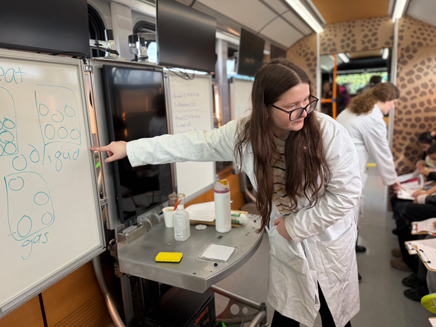
 This spring, something new started pulling into the parking lots of several Long Island schools. Through a partnership with Molloy, a Learning Bus—a fully equipped mobile teaching lab—is bringing hands-on STEM and literacy experiences directly to elementary students in the Farmingdale and Central Islip school districts.
Each visit welcomes entire classes throughout the school day, with approximately 125 students participating per day. Over the course of the semester, Molloy’s Learning Bus Initiative will potentially impact as many as 1,250 children.
Molloy’s School of Education and Human Services launched the project in early February as an equity-driven effort to support underserved communities across Long Island. Associate Dean Vicky Giouroukakis spearheaded the pilot program and said, “We were hearing from school districts that their students were not receiving enough hands-on, inquiry-based learning and, being in a service-based institution that prepares future teachers, it made sense to develop a program that would bring our own candidates into communities, especially under-resourced ones, to provide services and meet students’ needs. The partnership with BioBus came about through our commitment to bring experiential learning directly to under-resourced communities on Long Island. BioBus already had a strong model as a nonprofit mobile lab serving NYC schools, and the idea was to extend that reach to Long Island districts like Farmingdale and Central Islip. With grant support from the Amy Hagedorn Fund and private donors, we piloted the program this spring so students could start benefiting from it.”
The mission of BioBus aligns with Molloy’s mission of inclusive, service-based, transformative education. The nonprofit strives to help students of all ages discover science by creating opportunities for underserved populations to reach their full scientific potential, The teachers for Molloy’s pilot program are current Molloy students in the Teacher Education Department of the School of Education and Human Services. These teacher candidates create the curriculum and deliver the lessons under the supervision of a field supervisor, while receiving invaluable hands-on classroom experience.
Gianna DeFilippis,’27BS/MS, is one of those candidates who works directly with students on the Learning Bus, supporting activities that blend both science and literacy for elementary-aged students. Her role involves helping lead and guide the lessons, working with students one-on-one and in small groups, and keeping them engaged throughout each activity. She also explains directions, supports students who need extra help, and encourages participation so that they feel comfortable taking part.
DeFilippis said: “A big part of my role is building a positive connection with the students and helping create an environment where they feel excited to learn and are not afraid to try. It has allowed me to see learning in a completely different setting outside of a traditional classroom. I have to be flexible, think quickly, and adjust how I explain or support activities based on what each group of students needs in the moment. It has strengthened my confidence as an educator and helped me better understand how important engagement and connection are in learning.
What stands out most is how excited the students are, especially during the hands-on science activities. Even students who are initially hesitant become more involved once they feel comfortable and see that learning can be fun and interactive. It’s really rewarding to watch them gain confidence, ask questions, and take pride in their work. Experiences like this remind me why I chose education and how powerful it can be when students feel supported and encouraged.”
Another candidate, Katelyn Tierney, ’27BS/MS, works closely alongside her field supervisor, Monique Calabro, to actively plan and implement grade-appropriate science lessons for students in grades 2–4. In addition to lesson planning and instruction, she creates word wall banners and integrates instructional support to meet the needs of diverse learners, including English Language Learners (ELLs) and students requiring special education accommodations, intentionally incorporating strategies and scaffolds that promote accessibility, comprehension, and engagement for all students.
Tierney explained, “This experience provides me with the opportunity to engage in teaching within a unique, non-traditional learning environment. Being part of an inaugural initiative has allowed me to contribute to something innovative while also developing my own instructional skills in a highly applied setting. One of the most valuable aspects of this experience is the opportunity to collaborate closely with my field supervisor and receive immediate, actionable feedback following each lesson. Teaching the same lesson multiple times to multiple schools within the same day across different groups has allowed me to continuously reflect, adjust, and improve my delivery in real time. This cycle of teaching, feedback, and refinement has strengthened my instructional confidence and my ability to think flexibly and responsively as a future educator.
“Additionally, the nature of the Learning Bus requires adaptability and problem-solving, as many aspects of the program are still evolving. Navigating this environment has shown me the importance of being able to adjust plans on the fly, a skill that is essential in classroom teaching. It has reinforced that effective teaching often involves spontaneity, responsiveness, and the ability to meet students where they are in the moment.”
In addition to BioBus, the Long Island Children’s Museum (LICM) is interested in working with Molloy on this initiative. They have partnered with the Westbury School District to introduce a school-museum teaching model which expands the district's STEM program. The program helps students gain a deeper understanding of the curriculum and teachers learn ways to enhance their STEM instruction. Already, LICM has a model in place, and by partnering with Molloy, they will be able to continue their work and inspire our teacher candidates in designing high-interest, engaging STEM-literacy lessons. Further, both LICM and BioBus staff have offered to provide some hands-on learning for both the teacher candidates and the students.
Dr. Giouroukakis said that the initiative has gotten off to a great start. “There is tremendous energy and excitement among the elementary students and our teacher candidates, and the school partners have raved about the program and its impact on the children, particularly the increase in STEM engagement.”
The plan is to sustain the initiative and expand into additional districts while also including candidates from other departments in the School of Education and Human Services—Social Work and Clinical Mental Health Counseling—to provide support services, such as counseling and social-emotional learning.