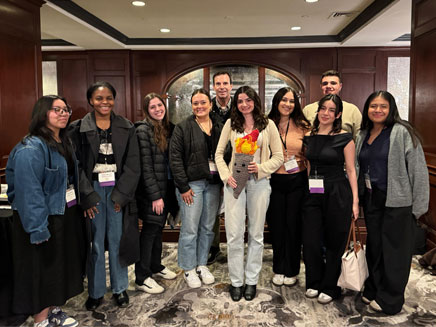
 Since 2014, the Molloy University Honors Program has sent over 100 students to the Northeast Regional Honors Conference (NRHC). This spring, 11 honors students presented their capstone projects at this year’s conference which took place in New Haven, CT on March 26-29 with the theme, Cultivating Innovative, Upstanding, and Impactful Leaders.
According to Elizabeth Mandracchia, the Honors Program Administrative Coordinator, "The presentations that our honors students make during the NRHC begin during their final semester of the Honors Program. All honor students must complete a capstone project in order to graduate with Honors Program distinction. Students who have completed the honors coursework are matched with a faculty mentor who assists in helping students design a project that synthesizes knowledge gained from academic and scholarly coursework and that of their travel and experiences relative to the program and their major. The honors students also have the privilege to share their insights with the Molloy Community and the option to submit their work to the National Collegiate Honors Council as well as the NRHC.”
At this year’s NRHC, three groups of Molloy honors students presented:
1. “Hidden in Plain Sight: Uncovering Human Trafficking on Long Island and Inspiring Action Through Awareness.” Presenters: Daniela Acteopan, Alba Aimee, Andrea Gardenas, Sasha Dornevil, Rachel Sirico, and Gianna Tallini
2. “Why the United States Should Adopt a More Global Approach to Special Education.” Presenters: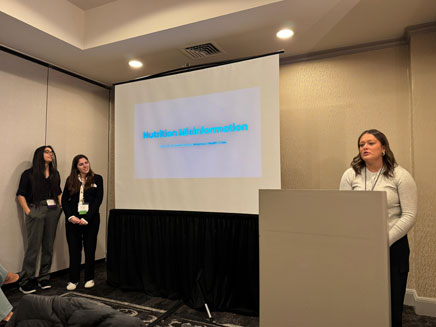 Joseph Stallone and Kayla Bonilla
3. “Nutrition Misinformation: How Social Media Shapes America’s Health Care Crisis.” Presenters: Claudia Chelchowski, Marissa Lopez, and Christina Mari
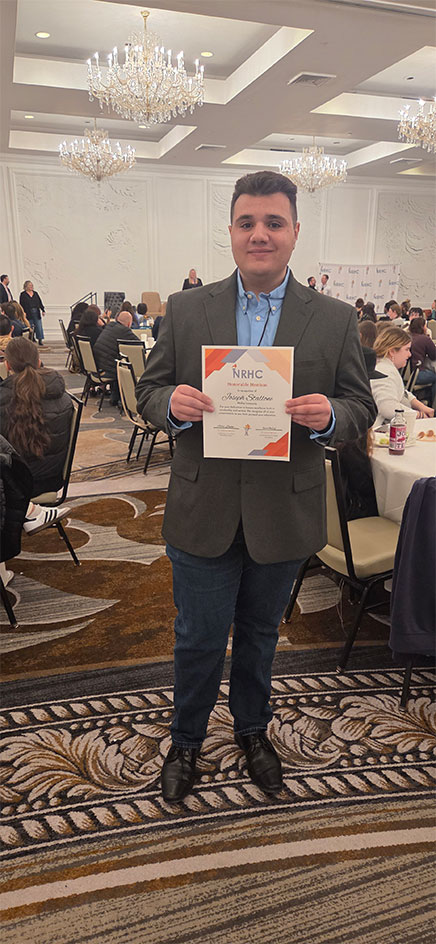
An exciting highlight of the conference was that one of those students, Joseph Stallone, ’26BS, received the Honorable Mention Award for Honors Student of the Year, 2026.
Discussing the inspiration for his project titled “Why the United States Should Adopt a More Global Approach to Special Education,” Stallone said, “When I traveled to Austria with the Molloy Honors Program to take part in the Global Citizenship Alliance’s Global Citizenship Seminar, I learned the phrase “Local Equals Global,” which means that whatever is happening in our communities has a global impact. When I started researching, it became clear to me that the international educational style is one the United States should adopt because the educational experience for students with special educational needs is vastly different in countries such as Finland, Greece, South Korea, and Australia. For this project, I flipped the phrase around to “Global Equals Local,” and my mindset was that we should be following the global community’s lead on this topic in order to provide the best education possible for special educational needs students.
This was the first time I was able to successfully integrate my interest in data analytics into my schoolwork. Using data analytics, I ran a regression analysis, which found that for every dollar spent per student on resources that pull special educational needs students outside of the mainstream classroom, their graduation rate decreases by 0.01%. I was astonished when I first saw that figure, but then I remembered the research I did on the global method for special education and I realized that the education programs in Finland, South Korea, and the other countries I studied all focused on integrating special educational needs students into mainstream classrooms with a mixed population of students (general education and special education), and that was further evidence to support advocating for integrated classrooms for all students.”
 Rachel Sirico, ‘26BSN, also presented at the conference and had this to say: “My group’s topic was “Hidden in Plain Sight: Uncovering Human Trafficking on Long Island and Inspiring Action through Awareness.” My interest in this project came from realizing that human trafficking is not just a distant, global issue, but something that is happening in our own local communities on Long Island. After watching the News 12 Documentary Trafficking in the Tri-State, I was honestly shocked by how prevalent and hidden the issue is, which made me want to learn more and help bring awareness to it. What especially interested me, along with my other group members, was the idea that small, everyday actions, such as posting hotline signs in public places, really can make a meaningful difference. One of the focuses of our group’s project was checking whether these signs were actually visible in places like restaurants, parks, and hospitals, which made the project feel very practical and impactful. I liked that we weren’t just researching the problem, but also evaluating real prevention efforts in our community. Overall, I was drawn to this topic because it combines awareness, advocacy, and the opportunity to inspire action in a way that can genuinely help people both in our very own local communities and on a global scale.”
Honors Program Director, Dr. Howard Ponzer accompanied the students to the conference and said, “The value of the Honors Capstone is that it gives our honors students the opportunity to work collaboratively on independently developed projects with regard to themes that connect local issues with global concerns. With the experience of presenting their capstone projects at the NRHC, our honors students acquire in real-time the initial building blocks of lifelong learning as independent professionals in the global community.”