For Molloy University business students, one of the world’s most influential centers of business and finance is not a faraway destination. It is just a train ride away.
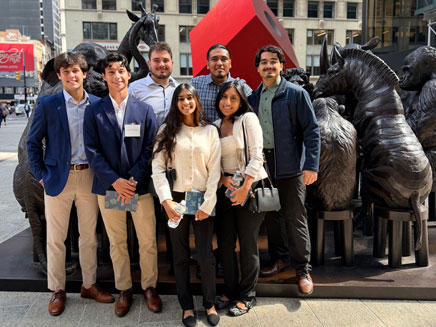
On Sept. 18, a group of students traveled to New York City with Steve Kent, assistant professor of economics and finance, for an immersive look inside some of the institutions that shape markets, economic policy and the global business landscape. With visits to the New York Stock Exchange, Federal Reserve Bank of New York and Bloomberg, the day offered students an opportunity to take concepts they encounter in the classroom and see how they operate on a much larger scale.
At the Federal Reserve, students had the opportunity to hear from John C. Williams, president and CEO of the Federal Reserve Bank of New York, as he discussed the economy and topics including inflation, unemployment and R-star, the estimated interest rate that neither stimulates nor restricts economic activity.
For Kent, hearing those concepts discussed in one of the institutions responsible for shaping U.S. monetary policy allowed students to connect economic theory with the conversations and decisions taking place beyond the classroom.
“When they heard John Williams talk about inflation, unemployment, R-star and other metrics, these are things we talk about in class and focus on in theory,” Kent said.
The visit also gave students a firsthand look at the significance and scale of the Federal Reserve Bank of New York, from its role within the nation’s financial system to the extensive security surrounding the institution and the massive quantity of gold stored in its vault beneath Manhattan.
A visit to the New York Stock Exchange offered another perspective on the financial world. Students toured the exchange, learned about its history and saw firsthand how technological advances have transformed trading. Kent wanted students to see the contrast between the traditional image of Wall Street and the way modern markets actually operate, with electronic trading replacing much of the face-to-face activity that once defined the exchange floor.
For Marcus Fasano ’27, a dual economics and business analytics major, simply stepping onto the floor was memorable.
“Visiting the New York Stock Exchange was something I had always envisioned doing,” Fasano said. “You see this area in movies and documentaries, but it’s nothing like seeing it in person.”
One moment in particular brought the activity of the market into focus. Fasano watched a figure displayed on one of the exchange’s screens nearly quadruple within approximately 20 minutes as
the closing bell approached. When he asked the tour guide why so much activity was occurring at once, her explanation offered an unexpectedly relatable comparison.
“She said, ‘When you are given an assignment for school, when do you submit? At the last second. It’s human nature,’” Fasano recalled.
For Fasano, who has already spent time investing on his own, the experience was less about encountering financial concepts for the first time and more about seeing them applied at an entirely different scale.
“The way we learn is already fairly applicable in a real-life sense, and that’s one of the beauties of business,” he said. “What was cool was seeing how it was applied on such a large scale, rather than purely on an individual level.”
That connection between academic learning and professional application is at the heart of experiential opportunities for Molloy business students. Located just outside New York City, the University gives students access to a region that is home to major banks, investment firms, financial institutions, corporations and countless other employers.
Kent sees that proximity as an important advantage for students beginning to explore their careers. Major financial firms throughout New York are continually looking for interns and entry-level talent, he said, and many of the executives leading those organizations began their own careers through internships or positions directly out of college.
Kent brings that perspective to his teaching from personal experience. Before entering academia, he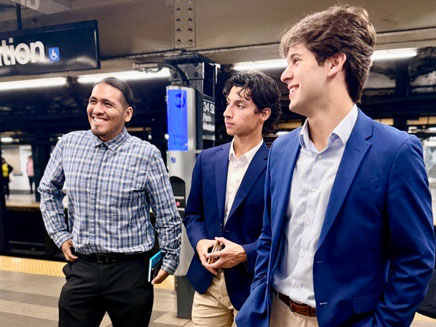 spent more than two decades at Goldman Sachs. Part of preparing students for the professional world, he said, is showing them that succeeding in business is not necessarily about finding a single perfect answer.
“They see that in business there are no perfect or right answers,” Kent said. “The traders, economists and other executives don’t have a perfect answer, but more of a range of outcomes.”
The day also included a visit to Bloomberg, where students experienced another side of the business and financial landscape. For Fasano, seeing the company's workplace and environment expanded his perspective on where a business degree could eventually take him.
“I could see myself being there, as I would love to be some form of analyst,” Fasano said. “When I visited the NYSE, I felt such a connection internally. I could see myself belonging there. Even if it was for a short time, I could see myself being involved in the market as some type of broker.”
That sense of possibility became one of Fasano’s biggest takeaways from the experience.
“The biggest thing I took from this experience is the number of options that are out there for us business majors,” he said. “One of the greatest things about being part of a school in New York is that we are right next to the city of finance. It’s only a train ride away, and we get to see what fuels our economy.”
For students preparing to enter an expansive and constantly evolving business landscape, opportunities like the September trip turn New York City into an extension of the classroom. They allow students to encounter industries firsthand, connect academic concepts with their real-world applications and, perhaps most importantly, begin to picture themselves occupying the offices, trading floors and institutions they once knew only from textbooks and screens.
For Fasano, the experience only strengthened his interest in the field.
“As someone who is quite passionate about the business world, it was one of, if not my favorite, experiences of my college career,” he said.
Asked what he ultimately hoped students would take away from the day, Kent summed it up in just four words:
“They can think bigger.”
Deprecated: strtolower(): Passing null to parameter #1 ($string) of type string is deprecated in phar://W:/Clients/Prod/molloy/docs/files/php/phar/brei.feedmanager.phar/Config/Config.php on line 40
Deprecated: strtolower(): Passing null to parameter #1 ($string) of type string is deprecated in phar://W:/Clients/Prod/molloy/docs/files/php/phar/brei.feedmanager.phar/Config/Config.php on line 40
Deprecated: strtolower(): Passing null to parameter #1 ($string) of type string is deprecated in phar://W:/Clients/Prod/molloy/docs/files/php/phar/brei.feedmanager.phar/Config/Config.php on line 40
Deprecated: strtolower(): Passing null to parameter #1 ($string) of type string is deprecated in phar://W:/Clients/Prod/molloy/docs/files/php/phar/brei.feedmanager.phar/Config/Config.php on line 40