 For Dawn McDonald, language has always been about more than words. It’s about connection, understanding, and helping others feel seen and heard.
Today, as a bilingual speech-language pathologist, McDonald uses that belief to support students and families every day. But when she first arrived at Molloy University in 2014, she never imagined that both her love for Spanish and her goal of working in healthcare would one day become part of the same story.
“I thought they were two completely separate paths,” McDonald said. “I knew I wanted to work in healthcare, but I had always loved learning Spanish and wasn’t sure how it could fit into my future.”
As she progressed through Molloy’s Speech-Language Pathology program, McDonald began to see how closely the two were connected after all.
Speech-language pathologists help people in all stages of life overcome challenges related to speech, language, communication, cognition, voice, and swallowing. Through coursework, clinical experiences, and research opportunities, Molloy prepares students to enter a field centered on helping others communicate, advocate for themselves, and build meaningful connections.
For McDonald, combining her clinical training with her Spanish studies opened the door to a career where she could make an even greater impact in her community. Her ability to communicate with Spanish-speaking students and families has allowed her to provide more accessible, personalized support while strengthening the relationships at the heart of her work.
“As I moved through my coursework, clinical experiences, research projects, and study abroad opportunities, I started to see how connected language, culture, and communication really are,” McDonald said. “Speech-language pathology became the perfect way to combine my interest in healthcare with my love of language.”
McDonald recognized that connection during a moment of encouragement from Dr. Susana Rubio, who suggested she pursue a double major in Spanish. At the time, McDonald questioned whether she could balance the additional coursework with the demands of her Speech-Language Pathology program.
“My immediate reaction was that it would be too much work and that I simply wasn’t good enough at speaking Spanish to major in it,” she said. But Dr. Rubio recognized her potential before she fully recognized it herself. “She told me that I was already doing remarkable work in her classes and that I was absolutely capable of succeeding,” McDonald said.
“Having someone I respected believe in me at a time when I doubted myself made a tremendous difference.”
That support became a defining part of McDonald’s Molloy experience. Faculty members challenged her to grow while ensuring she never felt alone in the process.
“One of the things that made Molloy special was that my professors truly took the time to get to know me,” McDonald said. “I wasn’t just another student sitting in a classroom. They knew my interests, my goals, and sometimes even the areas where I lacked confidence.”
McDonald’s passion for language continued to grow during her study abroad experience in León, Spain, which she describes as one of the most formative experiences of her life. There, Spanish became more than a subject she studied. It became a part of her everyday life. “For the first time, my brain fully shifted into the language because I was using it throughout my everyday life,” McDonald said. “I learned how to communicate in situations that simply don’t exist in a classroom.”
Living with a host family also changed the way she viewed language and culture. Although they came from different backgrounds, she discovered that connection often comes from understanding shared experiences. “That realization changed the way I think about language,” she said. “It became less about vocabulary and grammar and more about connection, understanding, and relationships.”
After graduating from Molloy, McDonald pursued her bilingual extension in speech-language pathology at Teachers College, Columbia University. She later became the first bilingual speech-language pathologist in her district, using the foundation she built at Molloy to advocate for bilingual students and families.
“My Spanish education has shaped nearly every aspect of my work,” McDonald said. “It allows me to communicate directly with families in their home language and build relationships that might not otherwise be possible.”
Her understanding of bilingual language development also helps ensure students receive support that reflects who they are, including their language backgrounds and cultural experiences. “Every student deserves to be understood within the context of their language and culture,” she said.
Looking back, McDonald credits Molloy with giving her the experiences and support that helped bring her passions together. “My coursework gave me knowledge, my clinical experiences helped me apply it, my research projects taught me to think critically, and studying abroad expanded my perspective in ways I never expected,” McDonald said. “By the time I graduated, speech-language pathology, Spanish, cultural understanding, and
service no longer felt like separate pieces of my life. They had become part of the same story.”
Today, McDonald is raising her children bilingually and sharing with them the same appreciation for language and culture that began during her time at Molloy.
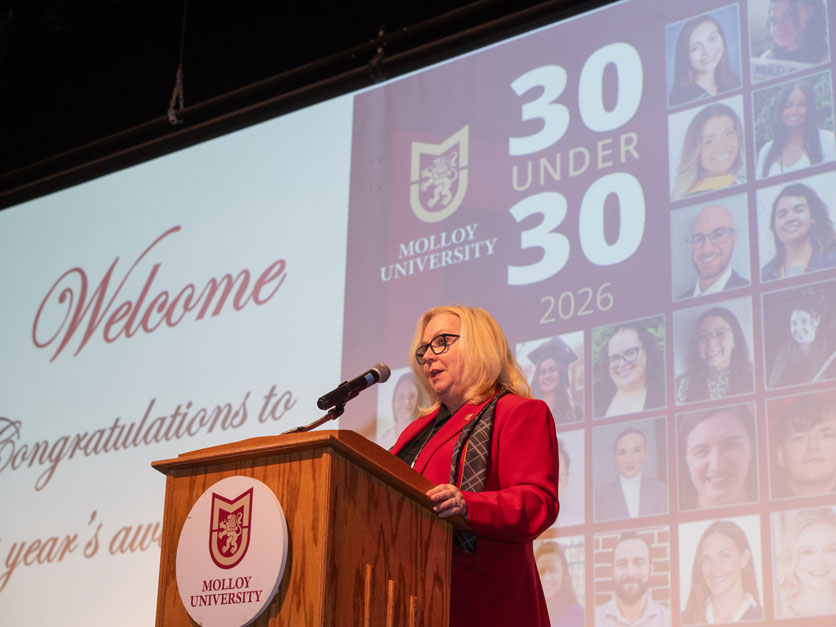
Years after beginning her journey, she returned to campus as the keynote speaker for the Alpha Mu Gamma Honor Society induction ceremony, where she encouraged students to recognize the lasting value of learning another language.
Even in a world with artificial intelligence and instant translation tools, McDonald believes nothing replaces the human connection created through truly understanding another language. “Technology can help us communicate, but it cannot replace the connection that comes from truly knowing a language and using it to build relationships with other people,” McDonald said. “Language learning is about much more than academics. It is about people.”
When she thinks back to the student who first arrived at Molloy unsure of where her interests would lead, McDonald says she never could have imagined the journey ahead.
“I never could have imagined that I would graduate with a double major, study abroad in Spain, become a bilingual speech-language pathologist, advocate for bilingual students, return to campus as a speaker, and raise bilingual children of my own,” said McDonald. “More than anything, I think she would be grateful for the opportunities, the mentors, and the experiences that helped shape a life and career that have been far more meaningful than she ever imagined.”
Deprecated: strtolower(): Passing null to parameter #1 ($string) of type string is deprecated in phar://W:/Clients/Prod/molloy/docs/files/php/phar/brei.feedmanager.phar/Config/Config.php on line 40
Deprecated: strtolower(): Passing null to parameter #1 ($string) of type string is deprecated in phar://W:/Clients/Prod/molloy/docs/files/php/phar/brei.feedmanager.phar/Config/Config.php on line 40
Deprecated: strtolower(): Passing null to parameter #1 ($string) of type string is deprecated in phar://W:/Clients/Prod/molloy/docs/files/php/phar/brei.feedmanager.phar/Config/Config.php on line 40
Deprecated: strtolower(): Passing null to parameter #1 ($string) of type string is deprecated in phar://W:/Clients/Prod/molloy/docs/files/php/phar/brei.feedmanager.phar/Config/Config.php on line 40